back to sierranevada.edu
Showing posts with label prelinger archive. Show all posts

Tuesday, December 28, 2010

Our Lady of the Preserved Sphere, & a Deadpan R.I.P.


Hope everyone had a safe and enjoyable new year's. Here's a parting shot from 2010 -- a few days ago the Library of Congress announced the 25 films they're preserving for 2010. In addition to catching up on some SNC art-related stuff over break, I wanted to link & embed a variety of interesting stuff to read & look at, for any of you out there jonesing for wider art-related material in between the family pleasantries and the wintersport exertions. The Library of Congress list provides a good excuse to embed some of the shorter films -- which can be found on youtube or elsewhere. There was a wide range of selections, ranging from pop-culture heavyweights to independent experimental films. Here's the list (If you want to read some descriptions of the films, click here. There are several personal favorites on it: "McCabe and Mrs. Miller," "A Tree Grows in Brooklyn," which is more tough-minded than its reputation might suggest, "The Front Page," "Airplane!", and I still have a soft spot for "The Empire Strikes Back," despite all the oxygen Star Wars sucks up in the culture. The one I most want to see, but haven't yet, is "make Way for Tomorrow," which sounds kind of devastating.)

1) AIRPLANE! (1980)

2) ALL THE PRESIDENT'S MEN (1976)

3) BARGAIN, THE (1914)

4) CRY OF JAZZ (1959)

5) ELECTRONIC LABYRINTH: THX 1138 4EB (1967)

6) EMPIRE STRIKES BACK, THE (1980)

7) EXORCIST, THE (1973)

8) FRONT PAGE, THE (1931)

9) GREY GARDENS (1976)

10) I AM JOAQUIN (1969)

11) IT'S A GIFT (1934)

12) LET THERE BE LIGHT (1946)

13) LONESOME (1928)

14) MAKE WAY FOR TOMORROW (1937)

15) MALCOLM X (1992)

16) MCCABE AND MRS. MILLER (1971)

17) NEWARK ATHLETE (1891)

18) OUR LADY OF THE SPHERE (1969)

19) THE PINK PANTHER (1964)

20) PRESERVATION OF THE SIGN LANGUAGE (1913)

21) SATURDAY NIGHT FEVER (1977)

22) STUDY OF A RIVER (1996)

23) TARANTELLA (1940)

24) TREE GROWS IN BROOKLYN, A (1945)

25) TRIP DOWN MARKET STREET, A (1906)

Of the experimental shorts, I've never had the chance to see Mary Ellen Bute's "Tarantella" (if you drop her name in youtube, you can see several of her excellent animations). Larry Jordan's "Our Lady of the Sphere" can be seen in a muddy transfer here (come to think of it, it's probably another source for the Ramona Falls video I blogged about a while back).


Click here for a bio of the San Francisco-based Jordan; if you want to see "Our Lady" in a decent transfer, it's on a DVD called "The Larry Jordan Album" -- review here, and you can order it here.

Another selected short available on youtube is from the Prelinger Archive, a great resource that I leaned on heavily, for raw material for the documentary class last semester. "A Trip Down Market Street" is one of the purest expressions of film-as-a-time-machine I've seen: a camera, affixed to the front of a trolley, glides down Market street in san Francisco, recording all the horses, bicycles, pedestrians, cops, and so on, that pass before its fixed gaze -- shortly before the 1906 earthquake hit, and obliterated much of the scene. As someone who made the Market street traverse several times in my decade+ as a San Franciscan, it holds a special sort of temporal whiplash.


You can download a copy of the film from the archive here. A youtube user going by the name lunarparcel created a side-by-side juxtaposition of the film, and a film taken on Market street after the earthquake, here.

Lastly, the inclusion of "Airplane!" allows me to segue into something I saw at the local Savemart a couple days ago -- a Leslie Nielsen birthday card that probably should've been retired, still hanging about on the racks. I hope Nielsen would find it funny. Though now we're beyond knowing:

Thursday, April 15, 2010

Dark Light

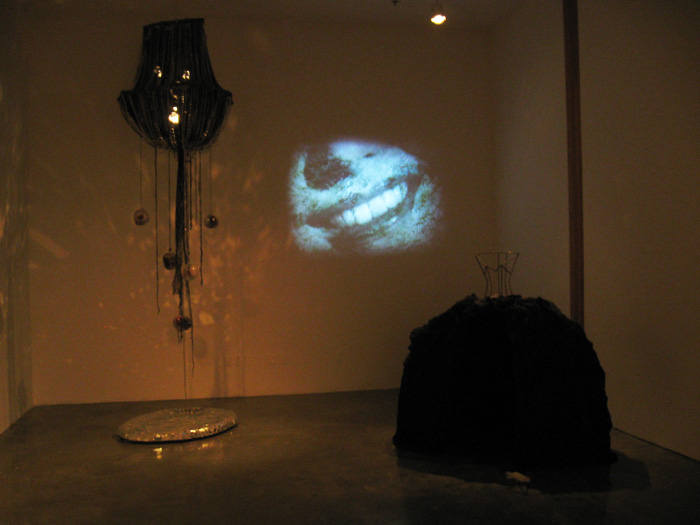
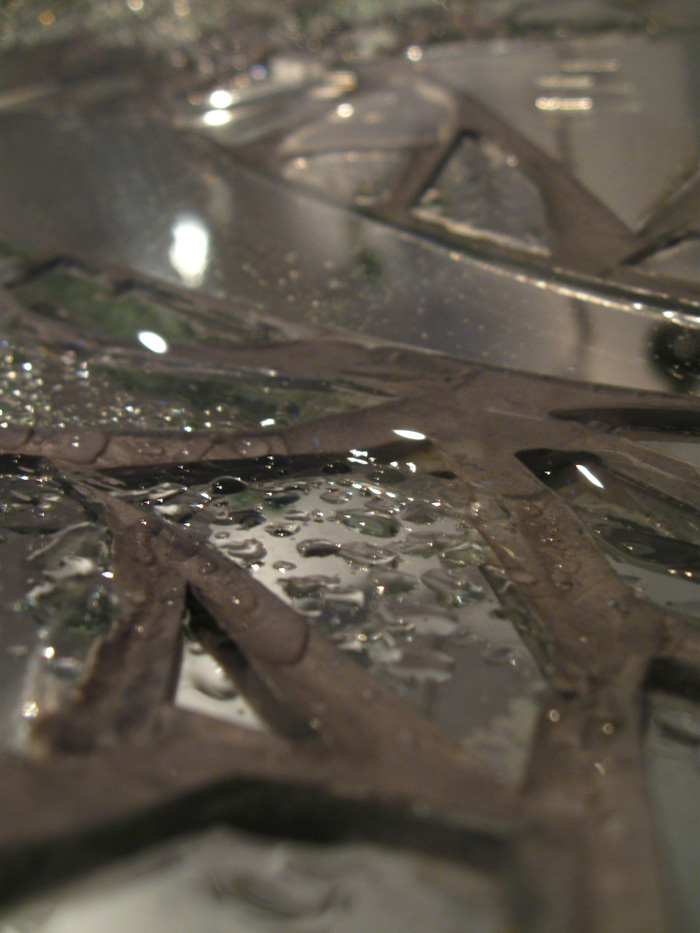
In Babs Laukat's BFA show, "Lustre Noir," the space was arranged around a series of inversions. Shapes squatting in a corner were echoed by shapes dangling from the ceiling, live flowers were set against a frame of artificial flowers, liquid water dripped and spattered against hard shards of glass. It was as if a set of conversions were being worked out: a sense of movement among the pieces made the images seem transactional, rather than static and resolved. A large chandelier (which, draped with tattered fabric, looked as much like a squid as a chandelier) held globes of ice, in which roses were frozen. As the ice melted, water dripped into a basin of shattered glass, which in turn sent fractured, melting shadows across the walls. A looped video projected onto the wall seemed at times to absorb these shadows and congeal them into more definite forms. Watching the video, you might gradually become aware that behind you, on a set of ascending shelves, orchids in glass containers were slowly growing, regardless of your attention. There was a subtle but consistent activity of dissolution, decay, growth, reconstitution.


In her talk, Babs explained her fascination with dualities, especially as they're worked out along the gender divide. She said she felt the present arrangement of dualities causes neurosis, and some of the seeds of her work were planted in a class on transpersonal psychology. In the work itself, Freud seemed to loom larger than Jung. An empty black dress, ruffled along a stark metal scaffolding, was parted to reveal a vacancy whose floor was covered in a thin layer of dirt. The humid chandelier patiently secreted its contents into the mirrored basin (the next morning, the collecting pool was faintly pink, suspending a solution of leached rose petal).


The opposition of gender stereotypes was "resolved" by a nearly life-size image of transsexual fashionplate (and David LaChapelle muse) Amanda Lepore, scaled and lit like an official portrait of a president, CEO or dictator (and actually, that scale might be too small for LePore, whose lips call out for billboard-sized framing). She stared out of the portrait like a surveyor of the work. The picture was cut off at the knees, but two arched shoes were set out in front of it, cobbled from welded steel.


The video, pieced together with public domain clips from the Prelinger Archive, dissolved stereotypically gendered images on top of one another. There is a cowboy riding a horse along a a plain, flowers that bloom in accelerated time lapse, a toothy female smile that stutters in an insistent loop, a mushroom cloud slowly raising its cephalopod dome, a quaint stripper who swings in and out of her disclosures between two luxuriant feather fans. Presented as a list, the images sound overdetermined -- and it would seem the switchbacks could only function as camp. But rather than editing from one image to the other, Babs superimposed them. Instead of being aware of cultural oppositions, you see connections being forged between them, in largely formal terms. A motion or a texture jumps from one image to the next, as they share a moment of time and interpenetrated space. The stamping of the horse's hooves seems to cause the flowers to burst open. The stripper emerges, diaphanous, from the convulsed clouds of a nuclear detonation, debris and dust shivering into fluttering feathers.


The work struck me as being strangely utopian. There was something gloomy about the space she created -- something dim and subterranean. At first glance, nothing seems to be truly resolved. Babs mentioned a desire to "solve the differences" that she sees in our cultural divides. But her synthesis seemed to rest on an embrace of artificiality, the way Amanda Lepore wears her femininity as an image, rather than a destiny.

Beyond that, however, the natural materials and processes evoked something more fundamental. The room had the kind of tenderness sleep can contain, when you're really craving it. I imagined Babs cultivating and caring for her images in the way she cultivated and cared for her orchids.